
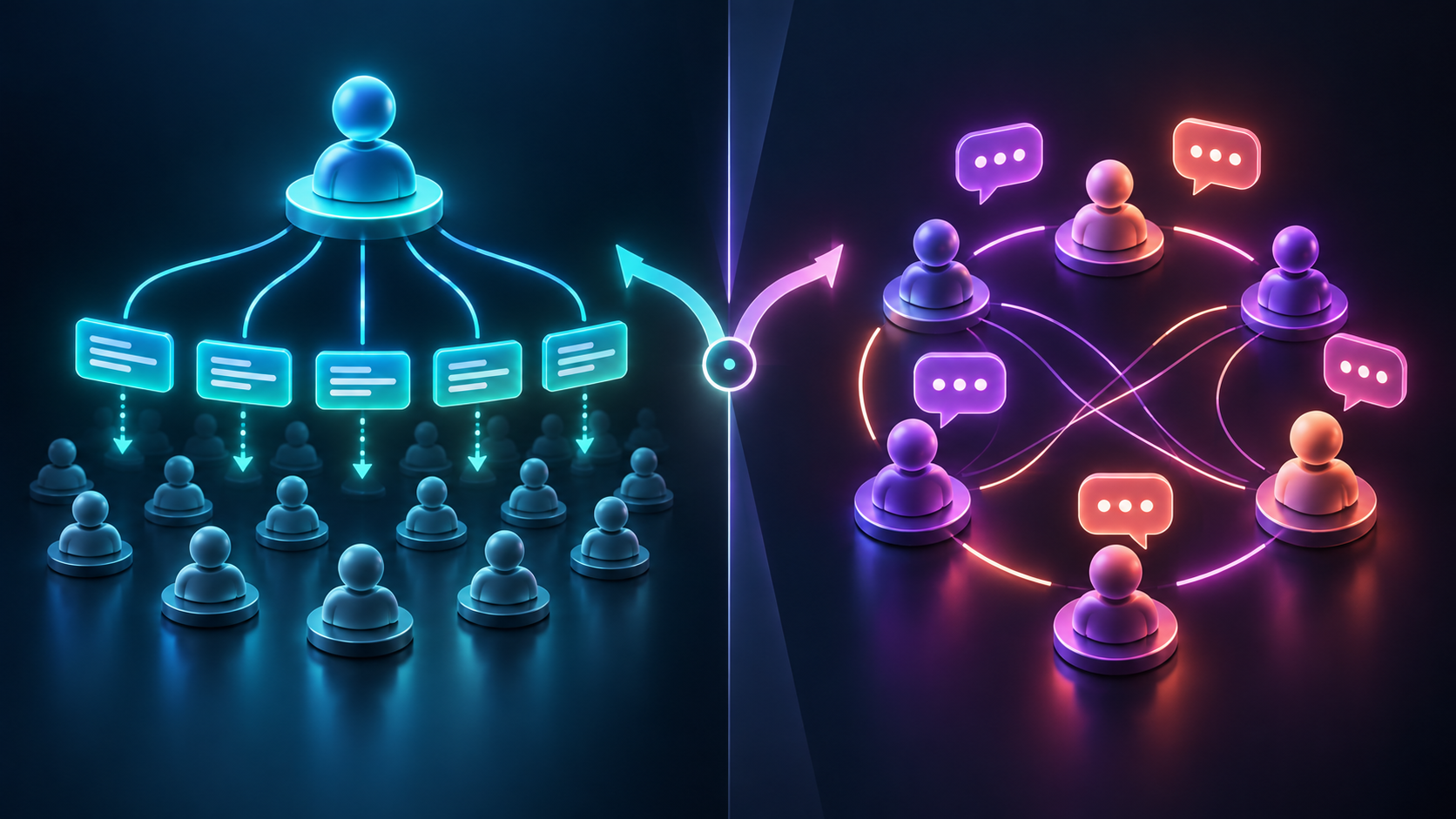
The core difference is the direction of communication. A Telegram group is built for conversation between members. A Telegram channel is built for broadcasts from administrators to subscribers. Choose a group when the audience creates value by talking. Choose a channel when the publisher creates value by delivering an ordered stream of updates. If you need both, connect a discussion group to a channel.
Telegram’s official FAQ currently states that groups can hold up to 200,000 people, while channels can broadcast to unlimited audiences. Capacity matters, but the operational differences matter earlier: who can post, where replies live, what must be moderated, and which audience label belongs in reporting.
Telegram group vs channel at a glance
| Decision point | Telegram group | Telegram channel |
|---|---|---|
| Primary job | Discussion and collaboration | Publishing and broadcasting |
| Audience label | Members | Subscribers |
| Who can post | Members by default, subject to permissions | Administrators and authorized bots |
| Conversation | Native in the main chat | Reactions, polls, or comments through a linked group |
| Scale | Up to 200,000 members under the current FAQ | Broadcast to an unlimited audience |
| Main workload | Moderation, support, permissions, community rules | Editorial planning, publishing rights, content consistency |
| Useful examples | Support community, class, project team, interest group | News feed, product updates, creator posts, announcements |
This comparison exposes a common setup error. A team creates a group because it wants “a community,” then discovers that it only needed an announcement feed. Another team creates a channel, then expects subscribers to start conversations in the main feed. The right choice starts with the intended behavior, not the biggest possible audience.
Write a message contract before creating anything
A message contract is one sentence that defines who publishes and who responds. It prevents feature lists from distracting the team from the actual job.
- Broadcast contract: “Our team publishes; the audience reads.” Use a channel.
- Conversation contract: “The administrator frames the topic; members discuss it.” Use a group.
- Hybrid contract: “The channel carries official posts; the linked group carries comments and support.” Use both.
A group can be restricted so only administrators post, but doing that removes much of the reason to use a group. A channel can support comments, but those comments live through a linked discussion group. They do not turn the channel’s main feed into an open chat.
Choose a channel for an ordered publishing stream
A channel fits when a small publishing team creates most of the value. Typical uses include product releases, news summaries, research updates, event notices, tutorials, creator posts, and operational announcements.
The format works best when the team can define:
- Who has publishing and deletion rights.
- Which content series will appear and how often.
- How important posts will be corrected or updated.
- Which outcomes will be measured beyond the visible subscriber count.
Channels keep the publishing stream clean because ordinary subscribers cannot add competing posts to it. That does not mean a channel automatically creates reach or engagement. Subscriber counts, views, forwards, and reactions describe different visible signals; none alone proves audience identity, attention quality, conversions, or customer demand.
Choose a group when member participation is the product
A group fits when the participants need to ask, answer, collaborate, or organize. Customer communities, study cohorts, project workspaces, local communities, event groups, and peer-support spaces all depend on member-to-member activity.
That freedom creates an operating cost. Before opening the group, assign responsibility for:
- spam and scam links;
- unanswered questions;
- joining rules and approval requests;
- slow mode, topics, and member permissions;
- private support cases that should not remain in public chat;
- escalation when moderators disagree.
An open chat is not automatically a healthy community. Without ownership, it can become a stream of repeated questions, promotional posts, and unresolved problems. A member count also does not show how many people read, return, contribute, or receive useful answers.
Use a linked group when publishing and discussion must stay separate
Telegram’s Channels FAQ says a channel can add a discussion group, which gives subscribers a comment button under channel posts. This is often the most practical structure for a content-led community.
Treat it as two connected products:
| Layer | Job | Evidence to review |
|---|---|---|
| Channel | Publish official content | Posting consistency, clarity, useful views or link actions |
| Discussion group | Host questions and peer conversation | Relevant replies, response time, spam volume |
| Moderation | Enforce permissions and escalation rules | Removals, restrictions, unresolved cases |
| Business outcome | Measure the result outside Telegram | Qualified visits, registrations, retention, support resolution |
Keeping these layers separate protects the analysis. A channel post can receive many views while producing little discussion. A group can be active without helping a product goal. Paid visible metrics, when used, require another reporting boundary: they must not be counted as organic participation or proof of community quality.
Make the choice with a three-pass test
Pass 1: Name the audience’s main action
If the visitor should read updates, choose a channel. If the visitor should talk to other participants, choose a group. If both actions matter but the formal feed must stay clean, use the hybrid structure.
Pass 2: Estimate the management burden
List the weekly work required for publishing, moderation, support, permissions, and reporting. A content team may be ready for a channel but not an open group. A community team with coverage and documented rules may be able to operate both.
Pass 3: Match the growth object
Telegram uses different objects and labels. Channels have subscribers, groups have members, and posts have views or reactions. Natural promotion and third-party services both depend on choosing the correct destination. A channel, group, and individual message are not interchangeable.
Teams asking what’s the difference between a telegram group and channel should settle that destination before comparing any audience service. A practical next step is to identify the Telegram object first, then review the current options on the live service page. PaxSMM separates group members, channel subscribers, post views, and reactions. Availability and delivery notes can change, so check the current service description before acting. Paid counts change visible metrics; they do not replace content, moderation, or genuine participation.
Mistakes that create expensive migrations
Using “members” and “subscribers” interchangeably
The words identify different Telegram objects. A member service for a group should not be treated as a subscriber service for a channel. The target link and expected result must agree.
Opening a group only to collect comments
If publishing remains the main job, a channel with a linked discussion group usually creates a clearer boundary. The channel holds the authoritative post; the group holds the conversation.
Choosing by capacity alone
Most new projects encounter editorial and moderation problems long before they encounter platform limits. Decide who will publish and moderate before optimizing for maximum size.
Treating visible counts as community quality
Members, subscribers, views, reactions, and comments answer different questions. They do not automatically establish who the audience is, whether people are active, or whether a business outcome occurred.
FAQ
How do Telegram groups and channels differ in daily use?
A group is a shared conversation space where members can usually post. A channel is a broadcast space where administrators publish to subscribers. Use a group for participation and a channel for ordered distribution.
Can subscribers post in a Telegram channel?
Subscribers cannot publish ordinary posts in the channel feed. They may react, answer polls, or comment when the channel has a linked discussion group and the relevant features are enabled.
How many people can join a Telegram group?
Telegram’s current FAQ says groups can support up to 200,000 people. Platform features and limits can change, so large-community plans should recheck the official FAQ.
Can a Telegram channel and group work together?
Yes. A channel can publish official updates while a linked group hosts comments and discussion. Assign permissions and moderation responsibility separately for each space.
Are channel subscribers and group members the same service target?
No. They belong to different Telegram objects and require the correct destination. Post views and reactions are separate again. Confirm the live service description and keep any paid count separate from organic audience reporting.
Final decision
Use a channel when the job is publishing. Use a group when the job is conversation. Use a channel with a linked discussion group when you need a clean source of truth plus a place for community response. That decision should come before audience acquisition, because the wrong structure makes every later workflow harder to manage and measure.