

Thousands of new Telegram channels look for their first batch of followers every single day. Buying Telegram members is a common practice in the SMM industry, but executing it poorly can lead to drop rates as high as 80%. This guide will walk you through the realistic costs of different member tiers, explain how drop rates actually work, and share practical steps to package your channel safely for a cold start.
Short Answer: Will Buying Members Ban My Telegram Account?
It is highly unlikely, but there are certain conditions. Telegram’s anti-spam algorithms primarily focus on punishing bots that aggressively send unsolicited spam, rather than the communities passively receiving members. If adding low-quality bots could easily trigger an automatic ban, malicious actors would have weaponized this long ago to take down rival communities.
Channels vs. Groups: The Critical Risk Difference
There is a notable difference in risk depending on the type of community you run.
Channels are generally safer: Channels operate as one-way broadcasting tools. Since regular members cannot post messages, adding synthetic members here rarely triggers spam filters.
Groups carry more risk: Groups are designed for two-way communication. If you buy the cheapest, scraped bot accounts for a Group, they might occasionally spam phishing links or unwanted ads. Real users will mass-report those specific messages, and a high volume of user reports is what typically gets a Group restricted or banned.
Why Do Communities Buy Telegram Members? The Role of Social Proof
If there are inherent risks, why is there still a demand for this? Primarily because cold starts require social proof.
If you launch a brand-new channel with excellent content but only 10 members, real visitors will likely assume the project is dead and click away. Buying that initial baseline data is just a practical workaround to lower the trust barrier. It's simple: nobody wants to be the first person to join an empty room.
Real Case Study: 2.1% vs. 14.7% Retention Rate
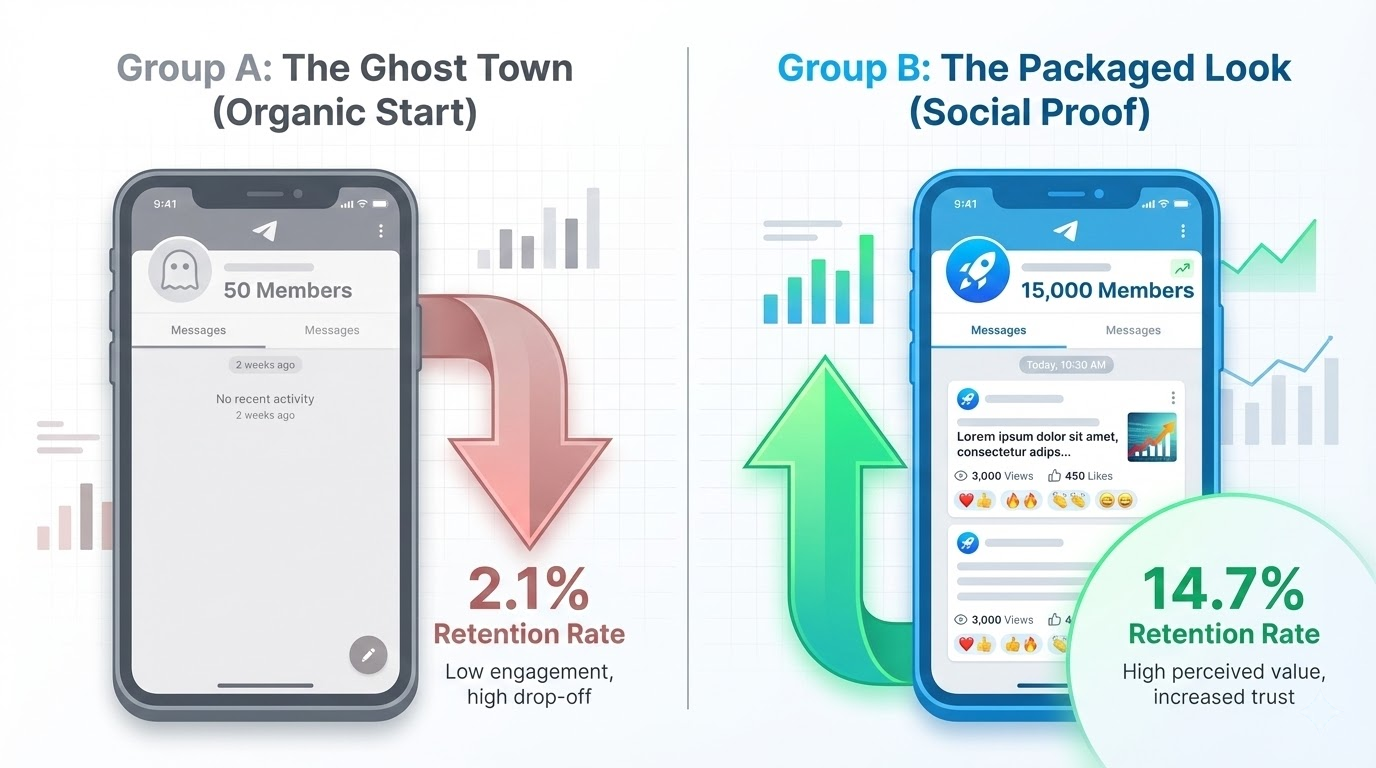
In a recent internal A/B test for an early-stage Web3 project, we drove identical paid ad traffic to two different community setups. (Note: This was a limited internal observation and should be treated as directional rather than universal.)
Group A (Organic Start): Directed to a brand-new channel with 50 real members. The retention rate of incoming real visitors hovered around 2.1%.
Group B (Packaged Start): Directed to a channel pre-loaded with 15,000 members and averaging 3,000 views per post. The retention rate of real visitors improved to approximately 14.7%.
This illustrates the practical value of buying stats: these members will rarely result in direct conversions, sales, or active discussions. However, they serve as a foundational layer that can help improve the retention rate of your actual marketing campaigns.
Who Should (and Shouldn't) Buy Members?
✅ Suitable Scenarios:
Brand new channels or groups (0-1,000 members) that need to break the ice.
Official brand notification channels requiring an immediate baseline of authority.
Marketers running external ad campaigns who need their community to look established to retain incoming paid traffic.
❌ Unsuitable Scenarios:
Anyone expecting purchased accounts to generate real sales, meaningful chat interaction, or link clicks.
Established groups that already have a stable, active organic community (adding synthetic members here can disrupt the existing ecosystem).
People searching for a "cheap way to buy real, high-quality customers." This simply does not exist.
Three Core Risks of Buying Telegram Members
While account bans aren't the primary concern for Channels, there are operational risks that can impact your budget and brand perception.
High Drop Rates During System Purges
This is the most frequent issue operators face. Telegram regularly updates its systems and purges inactive accounts. If you purchase the cheapest, one-off members from an unverified source, a large percentage of them may disappear during the next system sweep, essentially wasting your budget.
Imbalanced Engagement Metrics
Imagine a channel displaying 20,000 members but averaging only 5 views on recent posts. Experienced users can usually tell the community is artificially inflated. Poorly managed growth can harm your credibility. The issue isn't just having synthetic members; it's having a massive member count with zero engagement to support it.
Unreliable Resellers
Many services found on freelance platforms or social media are run by middlemen. They often charge a premium, deliver slowly, and may become unresponsive when you inevitably need to deal with drop rates and request refills.
Understanding SMM Panel Pricing and Quality Tiers
How do you evaluate a reliable provider? Look at the granularity of their services. Professional SMM panels break down their inventory by profile quality, delivery speed, and warranty periods.
If you look at the backend of most direct wholesale providers, you'll notice pricing is strictly tied to these factors. Here is a realistic look at current industry standards:
Cheap Basic Members (Under $0.20/1K)
These are bare-bones accounts, often lacking profile pictures or bios. Their main advantage is the low cost, but they are highly susceptible to drop rates. They are generally only suitable for strict budgets where a temporary numerical boost is the only goal.
High-Quality Members ($0.50 - $0.60/1K)
This is typically the recommended tier for standard operations. The accounts in this category look more realistic—featuring avatars and names. More importantly, they tend to offer better retention during purges and blend in more naturally.
Refill and Support Differences ($0.80+/1K)
The premium tiers are priced higher not just for account quality, but for the operational insurance they provide. These services often include long-term refill guarantees (usually 30 to 90 days), meaning the panel takes responsibility for replacing dropped accounts over an extended period.

Practical Steps to Boost Telegram Safely
If you’ve decided your project requires a data boost, following these operational guidelines can help minimize future headaches:
Start small
Avoid placing massive orders on day one. It is always better to start with a micro-test of 100 to 500 members. This allows you to monitor the provider’s delivery speed, verify the visual quality of the accounts, and observe the initial drop rate over a few days.
Match members with views
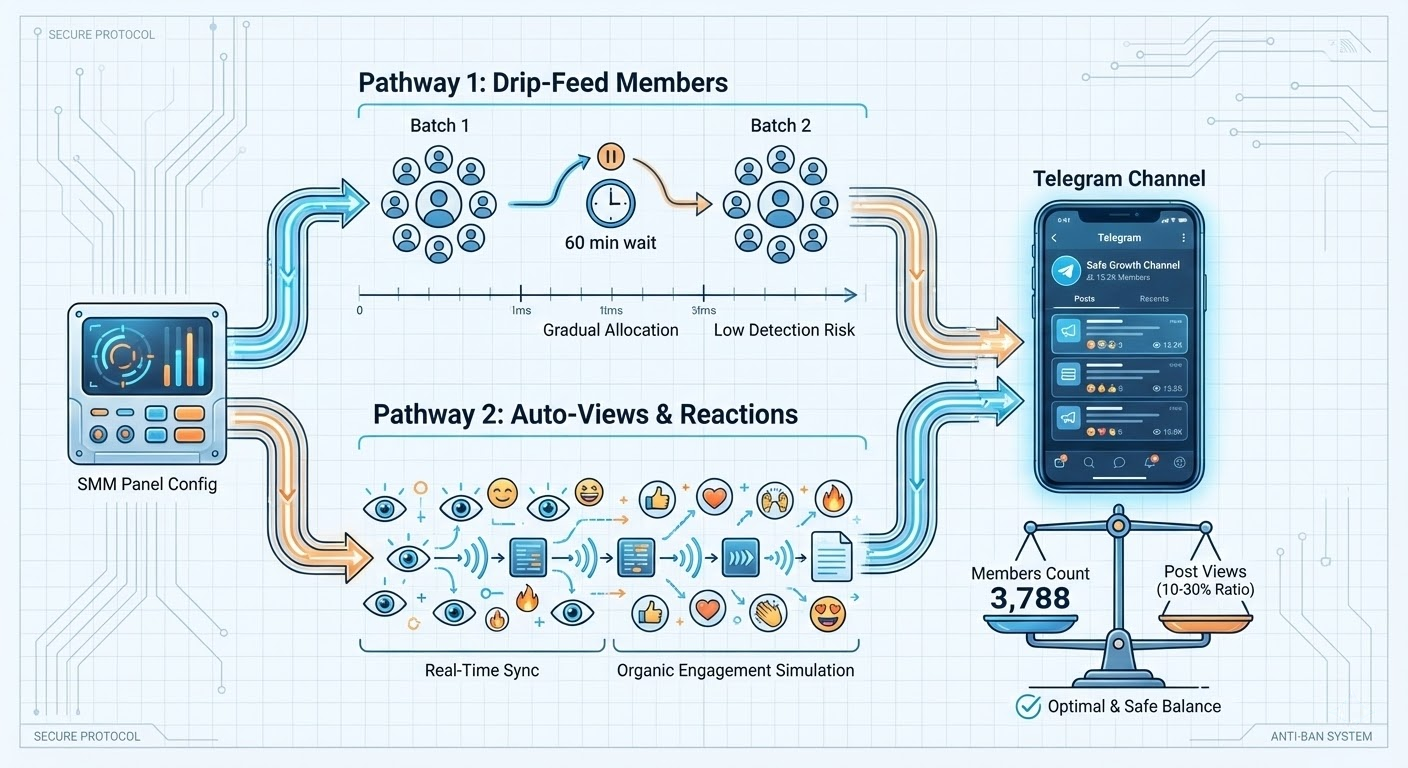
If you are adding members, you need to balance them with post views to maintain a logical ratio (typically keeping views between 10% and 30% of your total member count). From practical experience, manually buying views for every new post quickly becomes exhausting. Operators usually prefer setting up an "Auto-Views" task for future posts on their panel. By configuring this once, the system naturally adds views and scattered emoji reactions as you publish, freeing you up to focus on community management.
Use drip-feed
Experienced buyers rarely dump bulk data into a channel simultaneously. They utilize "drip-feed" settings to simulate a more organic growth curve. When placing an order, you configure the "Runs" (batches) and the "Interval" (time between batches). For instance, to add 10,000 members, you might set it to 10 Runs of 1,000 members, with a 60-minute Interval. This distributes the growth evenly over 10 hours.
Check the refill policy
For long-term projects, prioritize services tagged with a "Refill" or "Guaranteed" label. Avoid cheap "No Refill" services unless you are working on a short-term, disposable campaign.
FAQ
1. Do I need to provide my Telegram password? No. Legitimate SMM providers only require your public channel or group link. You should never share your password or login verification codes.
2. Can I buy targeted members from specific countries? Yes. Many platforms offer Geo-targeted members (e.g., from India, Russia, or the US). If your project focuses on a specific local market, using geo-targeted accounts aligns better with your overall data profile.
3. Will these members actively interact with my community? Generally, no. Standard members provide visual numbers. If you need engagement to make the channel look active, you typically need to manage that separately through targeted Post Views or custom interactions.
4. How long does delivery usually take? Delivery times vary by service tier. High-quality orders often initiate within minutes to an hour. For larger quantities, the system is usually designed to pace the delivery (drip-feed) to avoid unnatural spikes.
5. How are drop rates handled if I lose members? In daily operations, dealing with drop rates is routine. Rather than writing a support ticket every time you lose followers, experienced buyers look for an "Auto-Refill" button next to their order on their dashboard (a feature available on many professional panels). Clicking this triggers the system to check and replenish the count automatically. We recommend using manual support tickets only if this automated function fails or the warranty period is unclear.
Final Thoughts
Managing a new community from zero is challenging. While utilizing SMM tools is a common method to establish initial social proof, it requires a strategic approach.
The most practical advice is to test thoroughly. Run small, low-cost trials, observe the stability of the data, and ensure your engagement metrics (like views) match your member count. Once you understand the mechanics and limitations of these tools, you can use them as a controlled baseline to support your actual, organic growth efforts.