
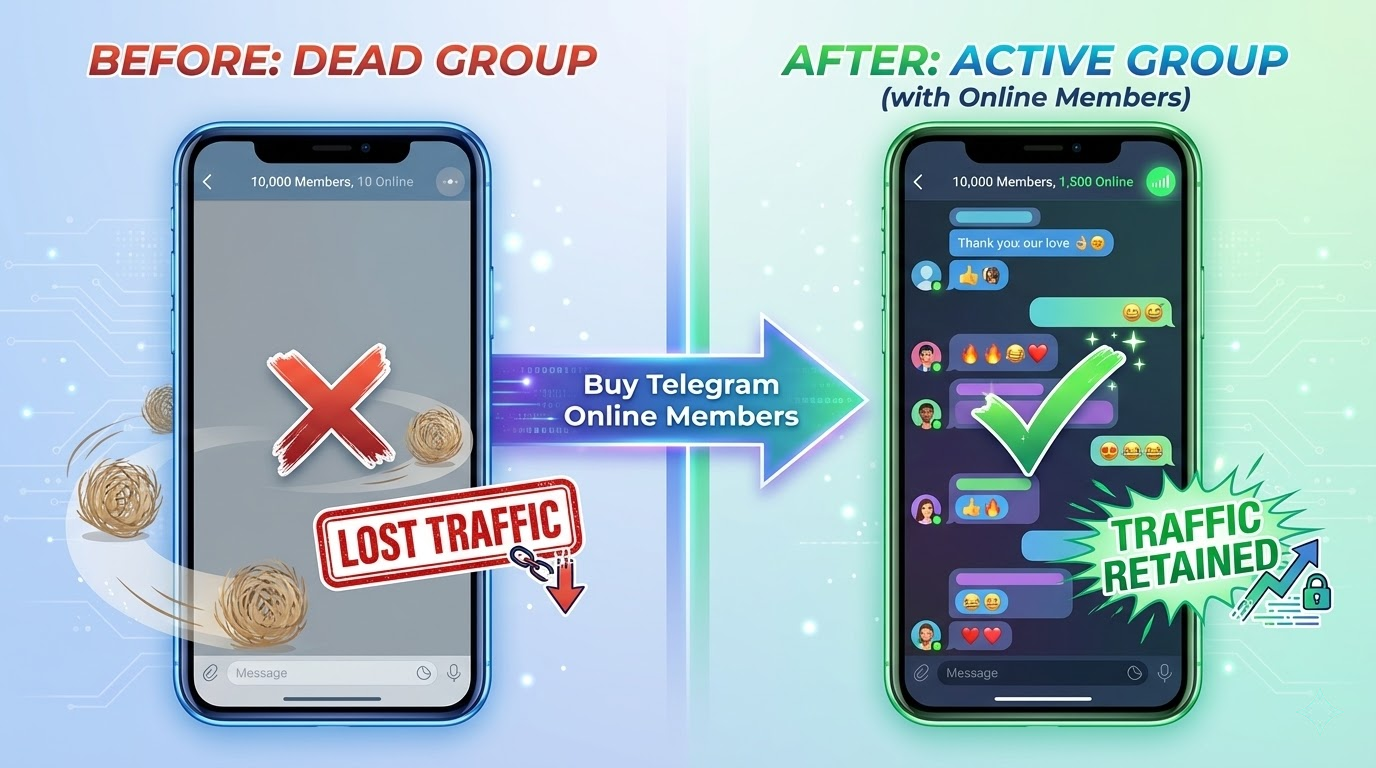
A group with 10,000 members and 10 people online does not feel like a community. It feels like a dead room.
That gap — large total count, almost nobody visible — is one of the more common ways expensive traffic gets wasted. Someone clicks through from an ad or a KOL post, enters the group, sees almost nobody online, and leaves before reading a single message. The money was spent on acquisition. The problem was in the container it landed in.
Online members exist to close that gap during the window when it matters most.
They are not a substitute for real community building. They do not generate real conversation or drive conversions. What they do is make the group look less abandoned during early growth, paid promotions, and the critical first-impression window.
What Are Telegram Online Members?
Regular Members vs Online Members
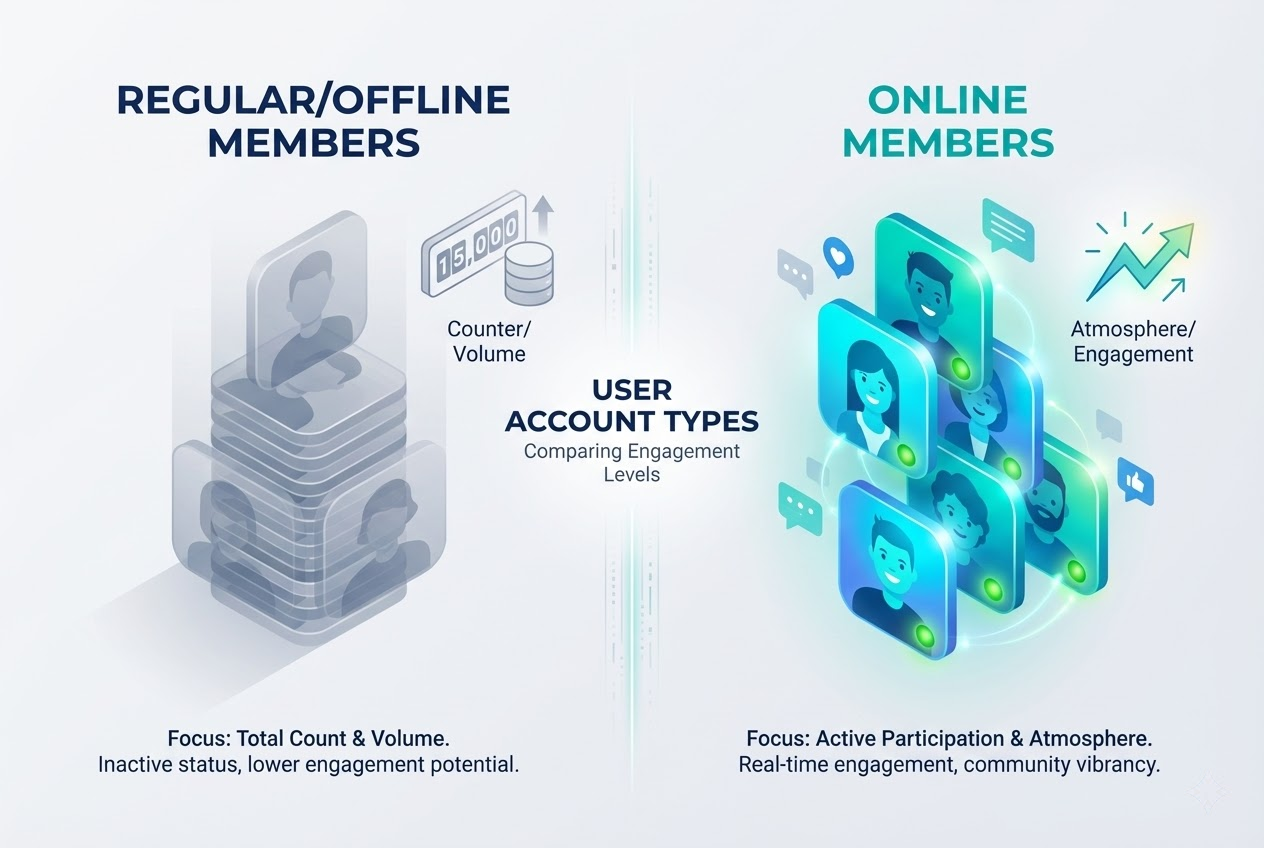
Regular members increase total count. They are usually inactive accounts that appear offline or show "last seen a long time ago." They help a group avoid looking too small, but they do nothing for perceived activity. If the ratio skews too far toward offline accounts, the visible online count collapses even as the member number climbs.
Market rate for stable non-dropping regular members typically runs around $0.2 per 1,000.
Online members work differently. They are maintained through dedicated servers to keep their session states active and contribute to the visible online count. Their cost is higher — usually around $1.2 per 1,000 — because the ongoing maintenance is higher. Quality matters here: cheaper providers often run on weaker infrastructure that drops faster after Telegram updates its detection logic.
Regular members support total size. Online members support visible activity. They are not interchangeable.
Why This Matters More Than People Admit
For crypto presales, Web3 launches, and any project running paid traffic, atmosphere is a functional variable, not a soft one.
We tracked a Meme coin presale on Solana that ran a mid-tier Twitter KOL push the day before launch — single post, 40,000 to 60,000 impressions, roughly $3,000 USD in spend. The team had pre-loaded regular members to push total count past 10,000, but added no online layer. Real visitors entered and saw a group with 10,000+ members and fewer than 20 people online. The count did not move. The group felt empty on first glance, and most traffic left before engaging with anything. First-day retention on that ad spend broke below 2%.
The spend did not fail because the audience was wrong. It failed because the group did not hold the traffic.
That said, online members are a poor fit for private communities, close-knit discussion groups, or any community where authentic conversation quality is the actual product. Injecting artificial presence into those environments usually makes the dynamic worse.
Group vs Channel: The Mistake New Buyers Make Most
Online members are a group product. Telegram channels do not display the same kind of real-time online count, so buying online members for a channel creates no visible effect.
If your asset is a channel, the metrics worth spending on are views and reactions — not online members. If your asset is a group, make sure the order is placed against the correct link before doing anything else.
Orders on a proper panel typically begin within 0 to 15 minutes. If a provider cannot give you a start time expectation, that is already a signal.
Why the Online Count Does Not Move Immediately
Placing an order and immediately watching the number at the top of the group is a normal instinct. It is also usually misleading.
Two things slow the count update down. First, batch account logins require Telegram's servers to process those session states — that takes time. Second, the visible online count in the client is cached, not real-time. A 5 to 15 minute lag is typical.
The practical move is to let the order run, give the system time to sync, and use that window to check your pinned messages and onboarding copy. The group state will catch up. Staring at it every 90 seconds will not accelerate it.
Can Online Members Help Telegram Search Visibility?
Search visibility on Telegram has historically tracked total member count and keyword match. But in operational practice, whether a group looks alive also appears to factor in.
A group that has maintained a consistent online presence tends to show up more reliably in search than a group with a similar size but a long history of silence. This is not a formal ranking rule — Telegram does not publish algorithm specifics. It is a pattern that shows up repeatedly in practice.
The effect tends to be more noticeable in lower-competition keyword spaces and with newer groups still building search presence. In high-competition categories or with established groups, the signal from online count is harder to isolate from other variables. The clearest cases are usually groups that combine a stable online layer with a few weeks of consistent, moderate member growth — both signals together seem to matter more than either alone.
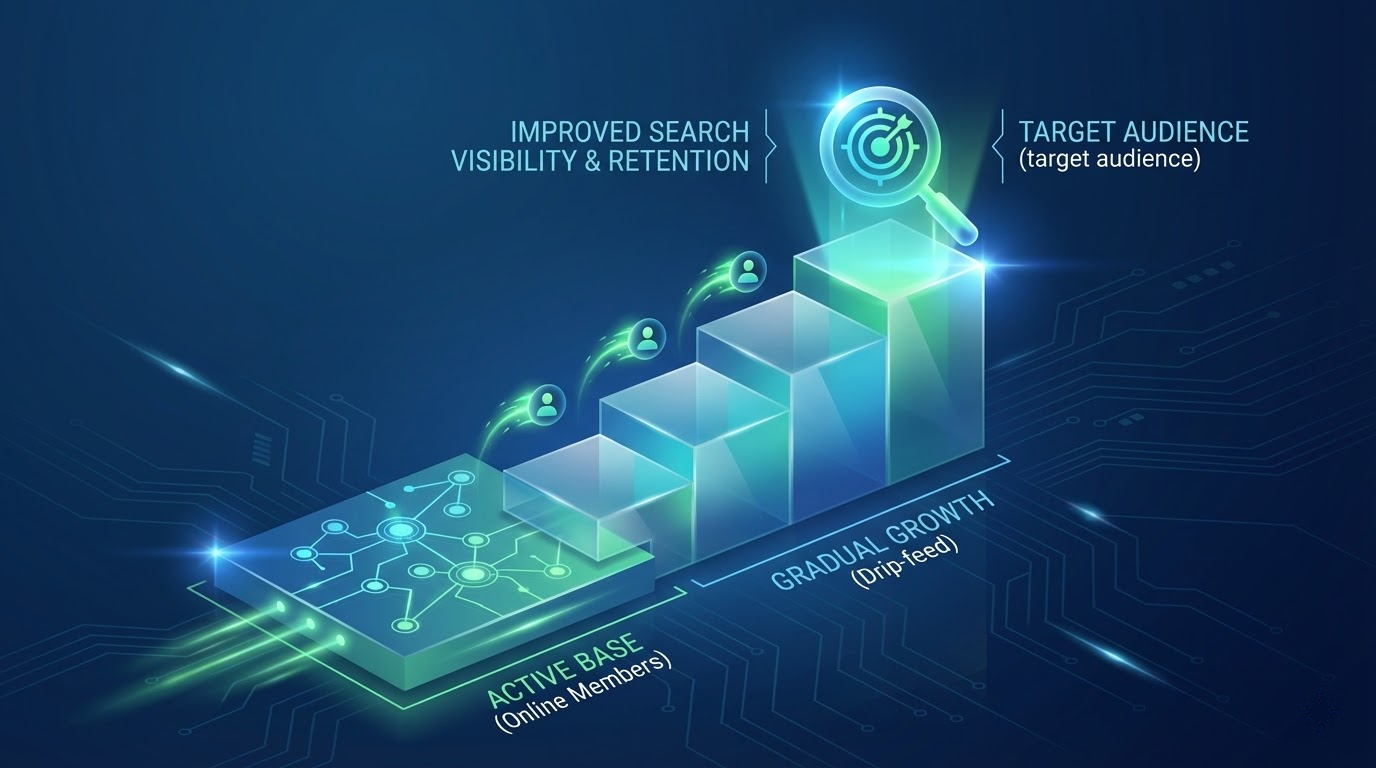
A Practical Growth Setup: Online Layer + Gradual Growth
Operators who use this well generally do not use online members as a standalone tactic.
A more functional setup:
Step 1: Stabilize the base. Run a longer-duration online member order that holds the group's visible activity ratio around 10% to 15%. This becomes the floor.
Step 2: Add gradual growth on top. Use drip-feed to add regular members or organic traffic daily over several days or a week — not a single spike. Consistent incremental change reads better to both search and new visitors than a one-time number jump.
The goal is not a big number on one day. The goal is a group that looks like it is consistently moving — which is a different thing.
Before doing any of this: check your current online ratio first. If total members are low and online count is already near zero, a small test order for 24 hours is a reasonable way to check the provider's drop behavior before committing to a longer run.
How Many Online Members Should You Buy?
A working range that tends to look believable is 10% to 20% of total group size.
Below 10% and the group can still feel empty, especially in a large group. Above 20%, the pattern often starts to look artificial to experienced viewers — a 50,000-member group with 15,000 online at 2am tends to read as manipulation.
The 10% to 20% range reflects how real groups distribute across time zones — some members always active, but never an implausible share of the whole.
For a 10,000-member business group, a common working configuration:
- Base layer: 8,500 to 9,000 regular members
- Online layer: 1,000 to 1,500 24/7 online members
This holds a reasonable visible count across all hours without the ratio becoming conspicuous. It is a starting point, not a formula — projects with heavy time-zone concentration or aggressive promotion windows may need to adjust.
How to Judge Whether a Service Is Stable
Price is a weak filter. Two providers at similar price points can have completely different infrastructure quality underneath.
Lower-cost services often use cheaper account pools and simpler scripts. When Telegram updates its detection logic — which it does periodically — those setups drop faster and recover slower. The visible activity you paid for disappears and is slow to come back.
More reliable providers tend to stand out less on branding and more on the specificity of their operating rules.
When evaluating a provider, four things matter more than the package name:
- Start Time — How long after payment does fulfillment begin?
- Guarantee Period — How long is the coverage window for drops?
- Drop Rate — Is there any stated expectation of typical stability behavior?
- Refill Rule — If drop occurs during the guarantee window, is refill based on actual quantity lost, and how fast is it executed?
A clear rule looks like this: members that drop during the guarantee period are refilled based on actual loss, typically within 24 hours. Providers who write vague language around refill — "we will try our best," "subject to availability" — tend to be the ones that make it hard to get anything back when drop happens.
Drop is a normal part of this category. The question is not whether it will happen. The question is whether the refill is fast enough and transparent enough to keep the group stable.
Risk Points Worth Knowing Before You Buy
Drop is expected. Telegram clears low-quality or non-compliant accounts periodically. This is not a sign the service failed. It is how the category works.
High online ratios are visible. If the count looks implausible relative to total size, real visitors will notice. Staying inside the 10% to 20% range avoids most of this problem.
Wrong asset wastes the budget. Online members on a channel produce no visible effect. Confirm the target is a group before placing an order.
Online count is not a retention solution. If members land and leave regardless of what the online count shows, the problem has moved downstream — to the offer, the pinned messaging, or the content quality. Online members improve first impression, not those variables. If post-purchase retention is still low after stabilizing online count, that is where to look next.
How to Use Online Members Without Wasting the Budget
Before traffic arrives: Make sure the target is a group. Set online count to a ratio that makes sense relative to current total members. Have pinned messages and onboarding content ready.
During a promotion window: Avoid dramatic spikes. A steady visible presence reads better than a number that jumps and falls. If adding regular members at the same time, use drip-feed over several days rather than a single large batch.
After traffic starts landing: Watch retention, not just online count. If users join and do not stay, online members have done their job and the problem is elsewhere.
FAQ
What does "online" mean in a Telegram group?
It covers members currently active on Telegram — not only people reading that specific group at that moment, but anyone with the app open and active. Protocol accounts maintain this state through server sessions.
Can online Telegram members create real engagement?
No. They can improve perceived activity. They cannot replace real users, real conversation, or real trust.
Is it better to buy regular members or online members?
They serve different functions. Regular members support total size. Online members support visible activity. Most operators use both at different ratios depending on project stage.
Can I use online members for a Telegram channel?
Usually not effectively. Channels are better evaluated through subscribers, views, and reactions. Online members are mainly a group-layer tool.
What is a reasonable online member ratio?
10% to 20% of total group size is the common working range. Lower can look inactive. Higher tends to look forced.
Why did some online members drop after delivery?
This is expected behavior in the category. Telegram clears accounts periodically. Refill policy matters more than promised uptime.
Do online members improve Telegram search ranking?
They may contribute indirectly by signaling consistent activity. They are not a standalone ranking factor. The clearest effect tends to appear in lower-competition keyword spaces, especially when combined with gradual ongoing member growth.
Final Note
A believable group is built on ratio and consistency — not on the biggest number available on the page.
Online members are a presentation layer. They are useful when the group needs to hold traffic and look less empty during early growth or promotion windows. They are not a growth strategy by themselves.
Use them to support incoming traffic, combine them with gradual member growth, and read the refill terms carefully before spending.