
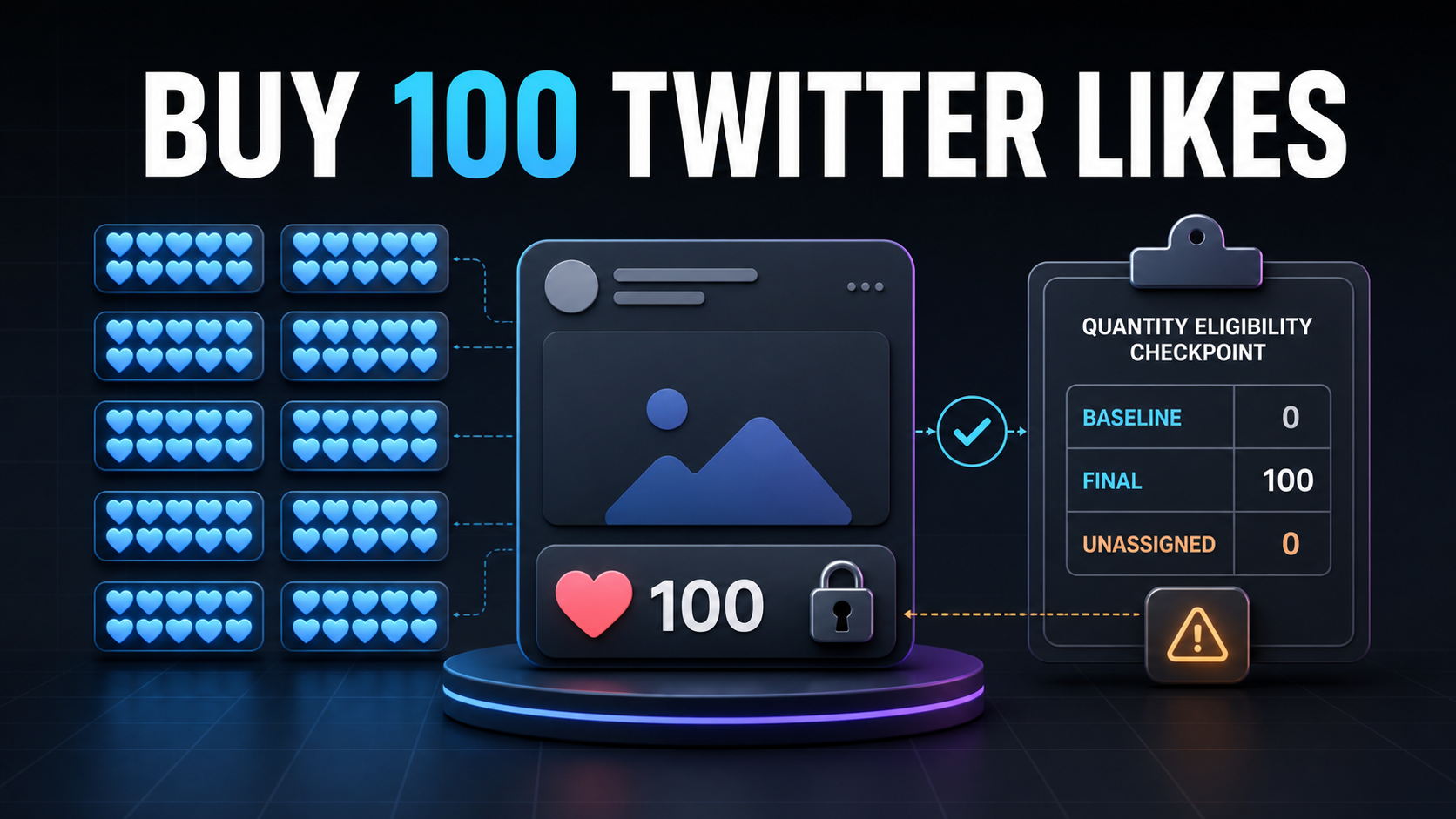
The phrase buy 100 Twitter likes looks like a product name, but “100” is only a requested unit count. It becomes a valid selection only when a live Twitter/X Likes item accepts that number and applies it to one public post. If the range starts above 100, if the control accepts different increments, or if the item delivers another metric, the proposed package does not exist for that selection.
That distinction matters because search results commonly present 100 as a universal tier. PaxSMM's current Twitter page does not make that promise. It says minimums, maximums, speed, and other conditions vary with the individual item. The correct task is therefore to classify the 100-unit request as eligible, ineligible, or indeterminate using live inputs.
X's Authenticity policy creates a separate boundary. It prohibits compensating others to inflate Likes and prohibits promoting third-party services that conduct those transactions. Quantity eligibility is not policy approval; an account owner may decide that the only acceptable quantity is zero.
A number becomes a package only after three tests
- m = the smallest quantity accepted now
- M = the largest quantity accepted now
- s = the allowed step or increment, if one is stated
Exactly 100 passes the range test when m ≤ 100 ≤ M. It passes the input test when the quantity control accepts 100 under its increment rule. It passes the metric test only when the selected item is Likes for a post—not followers for an account, views for content exposure, or reposts for redistribution.
| Result | What the live inputs show | Decision |
|---|---|---|
| Eligible | 100 is inside the range, accepted by the control, and attached to Likes | The quantity is technically selectable |
| Ineligible | At least one input rejects 100 | Do not relabel or split the request to force a match |
| Indeterminate | A limit, increment, metric, or target rule is missing | Ask for clarification or leave the selection unused |
This classification avoids a common mistake: treating a keyword, a competitor's checkout, or an old screenshot as proof of current PaxSMM inventory.
Keep the 100 units attached to one object
A one-post Likes item and an automatic future-post service are different products. So are 100 likes on one post and 20 likes on each of five posts. Unless a live item explicitly supports distribution, the quantity should be interpreted as one indivisible request for one public post.
Only a small identity card is needed:
| Identity element | Accepted value |
|---|---|
| Platform object | One accessible Twitter/X post |
| Metric | Likes |
| Quantity | 100, if accepted live |
| Owner reference | The post author's @handle |
| Stable locator | The full post URL and its numeric post identifier |
A profile address fails the object test. A reply URL identifies the reply, not necessarily the thread opener. A quote post is its own post. These distinctions are about selecting the intended object, not about making paid activity appear natural or avoiding enforcement.
Use a quantity-conservation sheet
The sheet begins with a requested quantity R = 100. Add a starting public count B and a later public count F. The visible movement is V = F − B.
Do not turn that formula into V = paid likes. During the interval, ordinary visitors may also use the Like button, and X may adjust displayed counts. The public counter provides a total, not a source-by-source receipt.
The useful sheet has five cells:
- R: requested units, fixed at 100.
- B: starting counter and observation time.
- F: later counter and observation time.
- V: total visible movement.
- A: attribution note stating that V may combine unrelated activity and count adjustments.
The sheet can show that the intended post was observed and that its public total changed. It cannot establish the identity, interests, location, or intent of the accounts behind the change. It also cannot prove recommendation, clicks, profile visits, qualified inquiries, or sales.
Interpret gaps without inventing a cause
Three numerical patterns may appear:
- V is below R. The observation does not establish why. Timing, unrelated adjustments, the chosen item, or another service condition may matter.
- V equals R. The arithmetic aligns, but exact source attribution is still unavailable from the public counter.
- V is above R. The excess may include ordinary activity or other events; it is not evidence of a bonus quantity.
Use neutral language for all three. “Visible movement was 84 during the interval” is supportable. “Sixteen paid likes disappeared” is not supportable from the counter alone. Likewise, “the extra 12 were organic” would be an unsupported claim.
This is the core value of a 100-unit worksheet: it prevents a precise request from creating false precision in the conclusion.
Decide whether 100 is better than no paid unit
A package-selection decision should include the zero option. Compare the proposed 100 visible units with actions that measure real response directly: publish another original post, answer relevant replies, improve the landing page, run a compliant ad, or review native analytics. Those alternatives do not make an engagement transaction compliant automatically, but they avoid treating a purchased counter change as audience evidence.
Choose zero when the brand prohibits purchased engagement, the account owner has not authorized the activity, the X rule conflict is unacceptable, the live item does not accept exactly 100, or the team expects the result to prove business impact.
Choose “indeterminate” rather than guessing when the item description does not expose a limit or target rule. Missing data is a valid selection outcome.
Read the PaxSMM page as a live classifier
The PaxSMM Twitter page currently separates followers, post or video views, likes, and reposts. It describes Likes as a public-post-URL option and tells readers that limits and service conditions vary. That makes the page useful for classifying a proposed quantity, but it is not evidence of permanent availability or compliance with X rules.
If the policy decision has already been made, open the buy 100 Twitter likes page and fill only the classifier inputs: metric, object, minimum, maximum, and accepted quantity. Do not proceed when the result is ineligible or indeterminate.
FAQ
Is 100 a permanent Twitter likes tier on PaxSMM?
No permanent tier is established by the public page. The individual live item must accept 100 under its current limits and input rules.
Can a 100-like quantity be divided across several posts?
Not by assumption. A single-post item applies to one public post unless its live description explicitly supports another distribution model.
What if the visible counter moves by exactly 100?
The arithmetic aligns with the request, but the public total still does not identify the source of each like. Keep an attribution limitation in the worksheet.
What if the counter moves by more than 100?
Report the total difference and the interval. Do not label the excess as organic or promotional without separate evidence.
Does an accepted quantity mean the activity follows X rules?
No. Technical acceptance by a service and compliance with X policy are separate questions. X currently prohibits compensated metric inflation, including Likes.
Should an account provide login credentials for this selection?
The PaxSMM page describes Twitter Likes as using a public post URL. A selection should not require a password, verification code, session cookie, or API key.
The 100-unit verdict
Exactly 100 is a usable selection only when live limits accept it, the item delivers Likes, and one public post is the object. The later public counter can be reconciled, but not perfectly attributed. Keeping those boundaries intact makes the worksheet honest—and makes “ineligible,” “indeterminate,” or zero legitimate outcomes rather than failures to force a package.